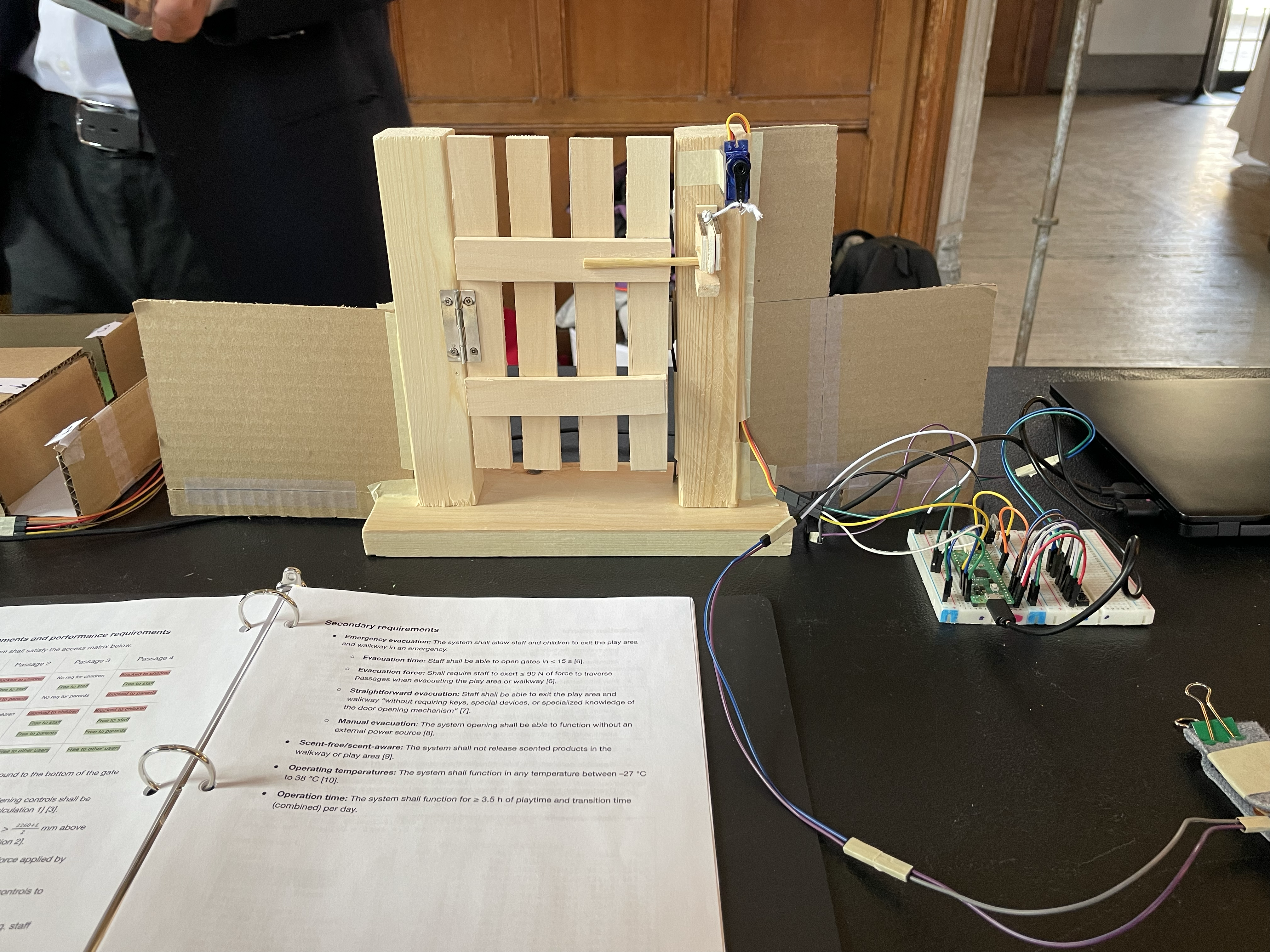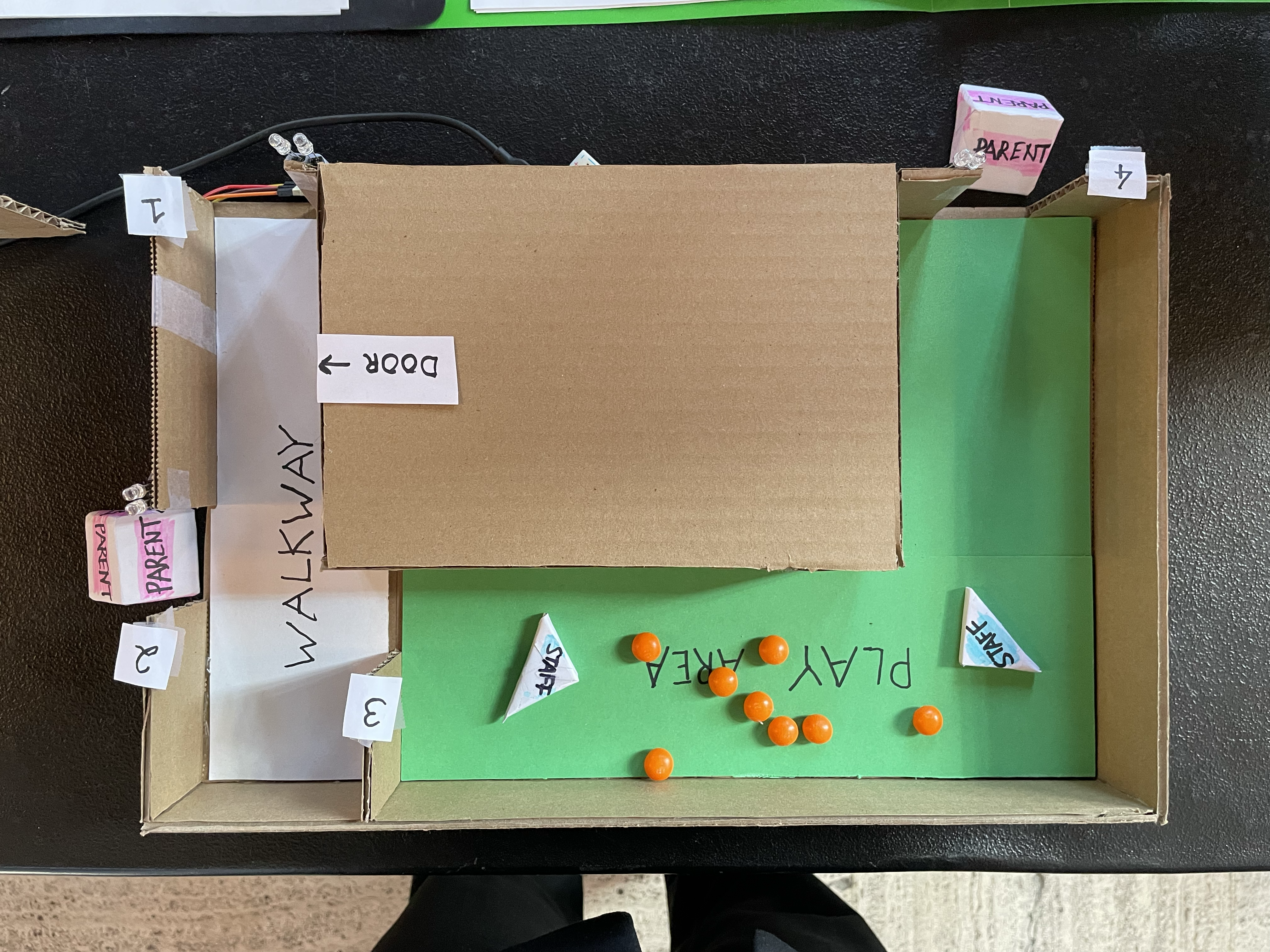
Overview
The Opportunity: At Friends Daycare (ages 2.5–5), unsecured gates allowed children to attempt unsupervised exits, requiring continuous staff monitoring during outdoor play — adding cognitive and physical burden to an already high-demand environment.
The Challenge: Any solution had to simultaneously satisfy four competing needs: prevent child exits, reduce staff workload, allow parents to enter independently, and not interfere with non-daycare use of the shared outdoor space.
My Role: Working in a team of five, I led the stakeholder mapping and prioritization framework that structured all downstream design decisions, applied steelmanning to identify and remediate critical security vulnerabilities, and conducted the Pugh chart analysis that determined the final gravity latch height based on material sustainability rather than arbitrary averaging.
The Outcome: A fully integrated gate and wristband system with justified, evidence-backed specifications — including a 1548 mm latch height selected over the research-range average (1678 mm) on principled sustainability grounds, and barrier panels dimensioned to 95th-percentile reach data.
System Architecture
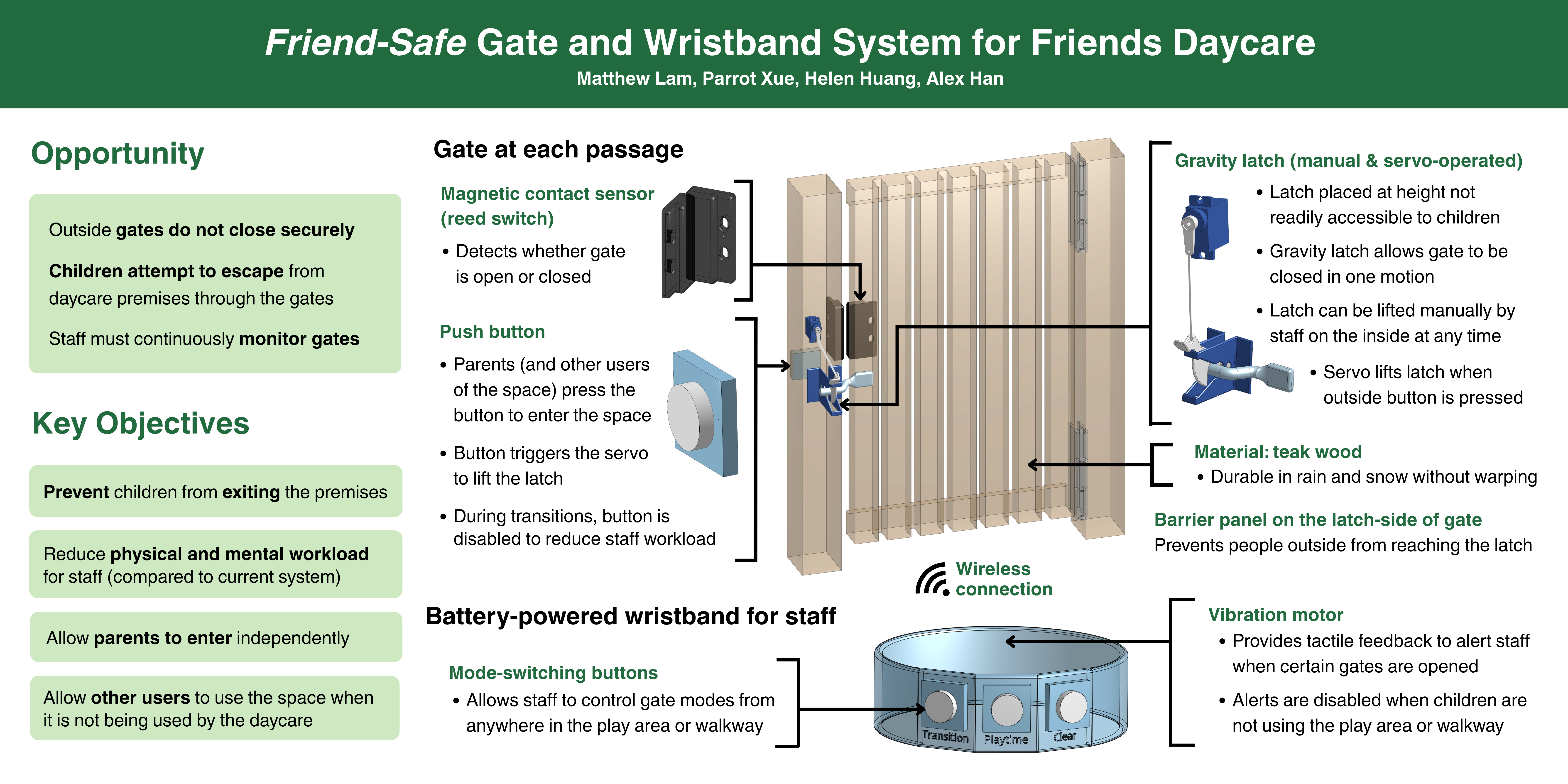
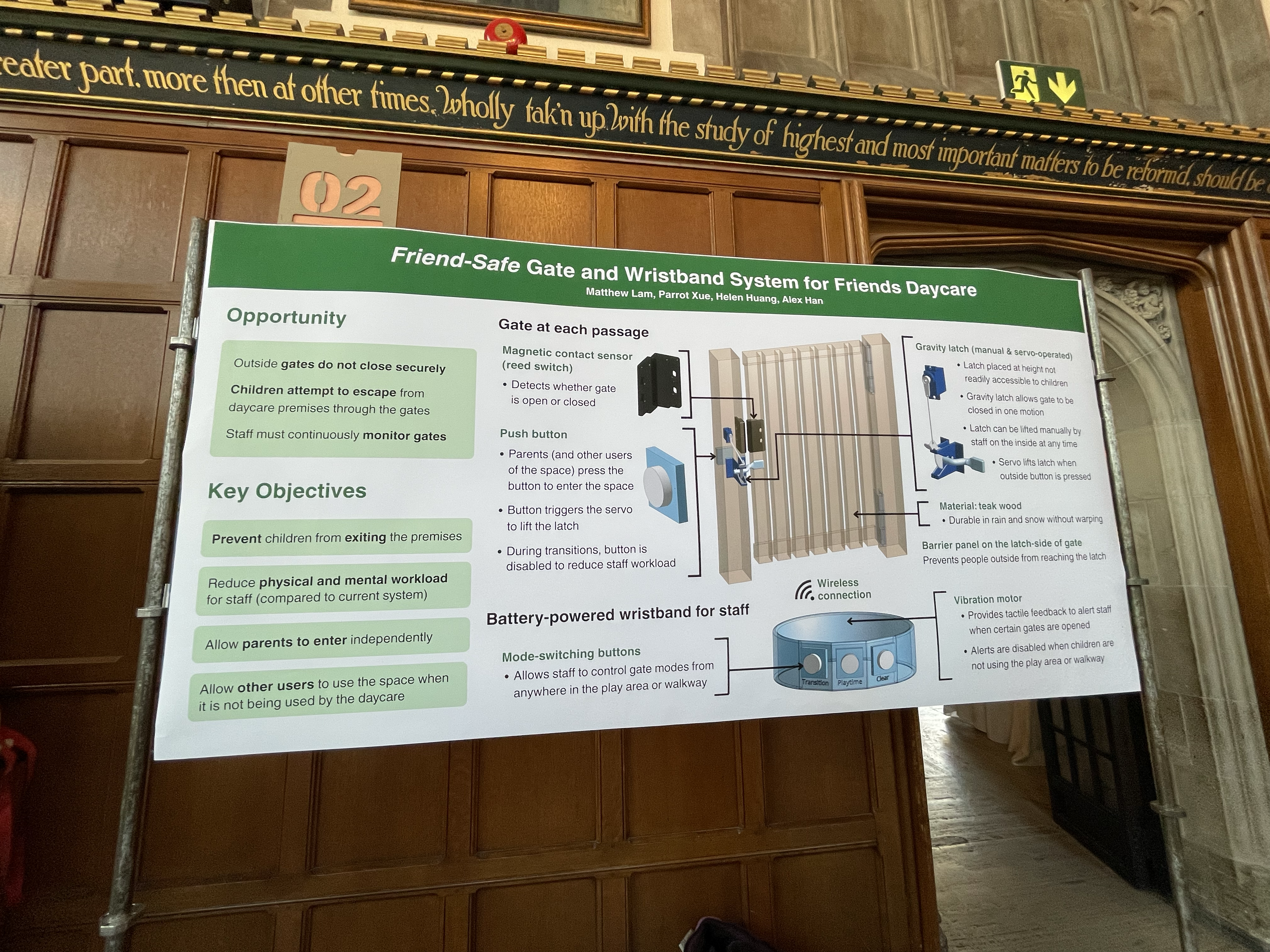
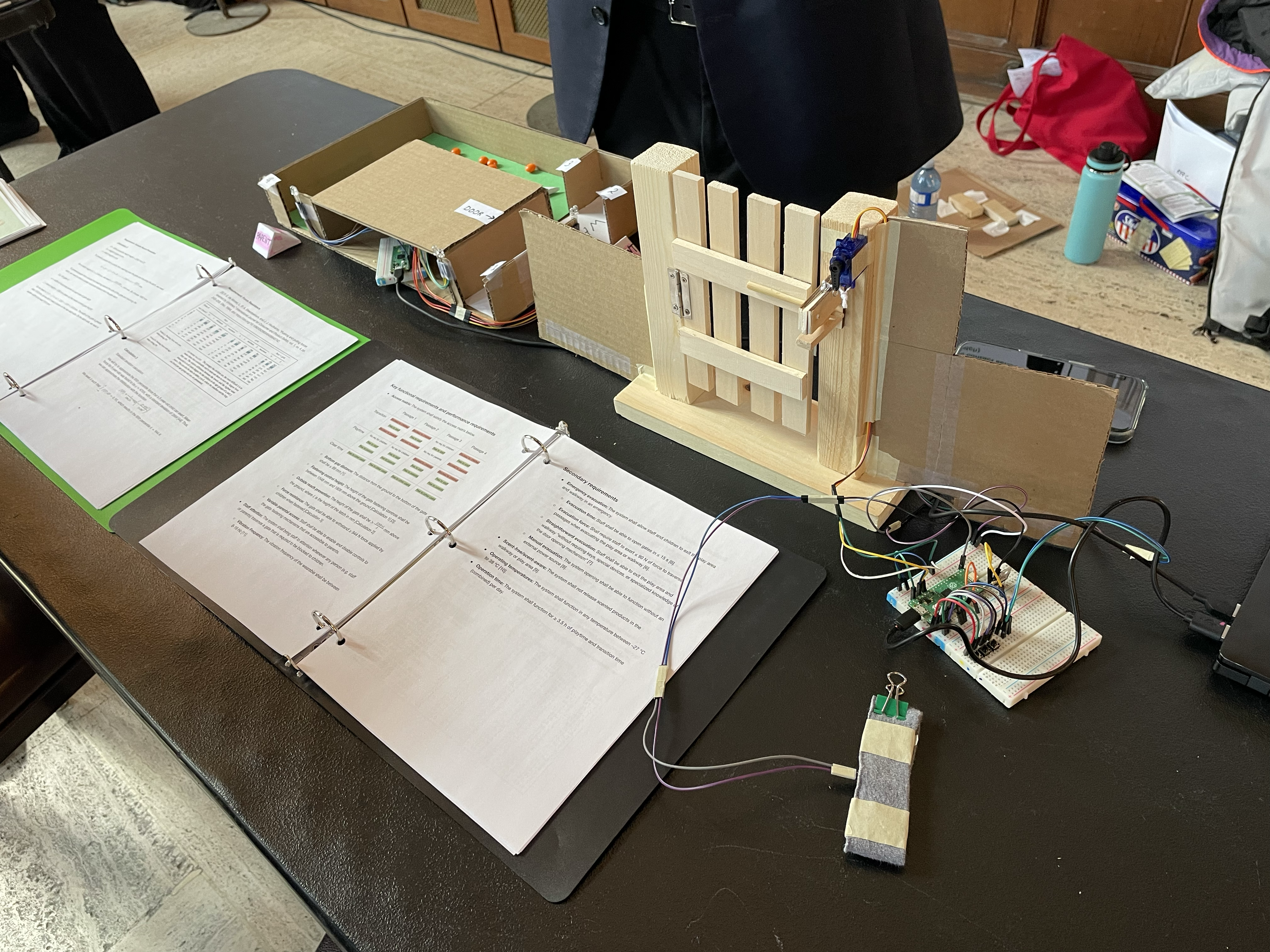
Gate System (at each passage)
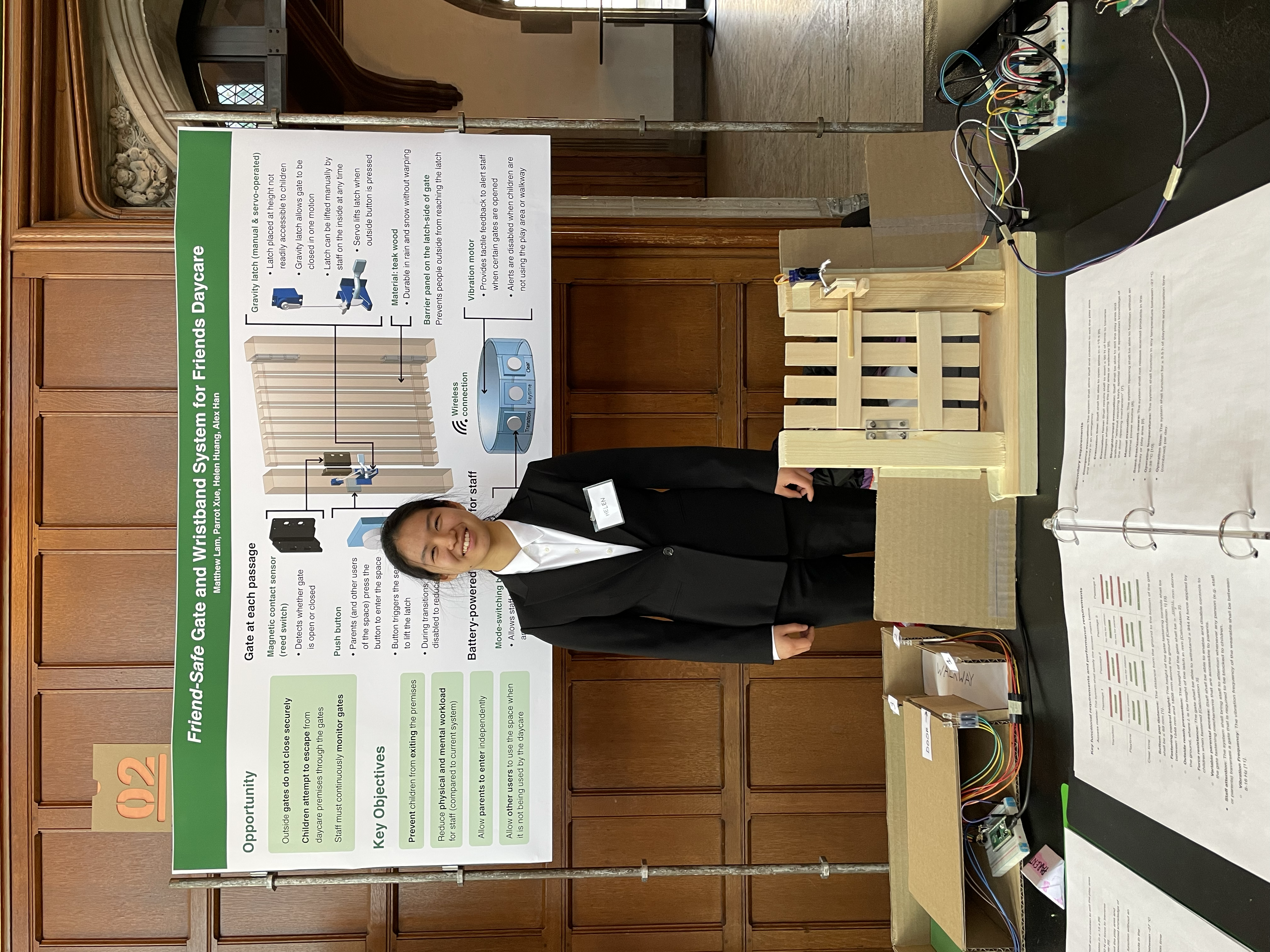
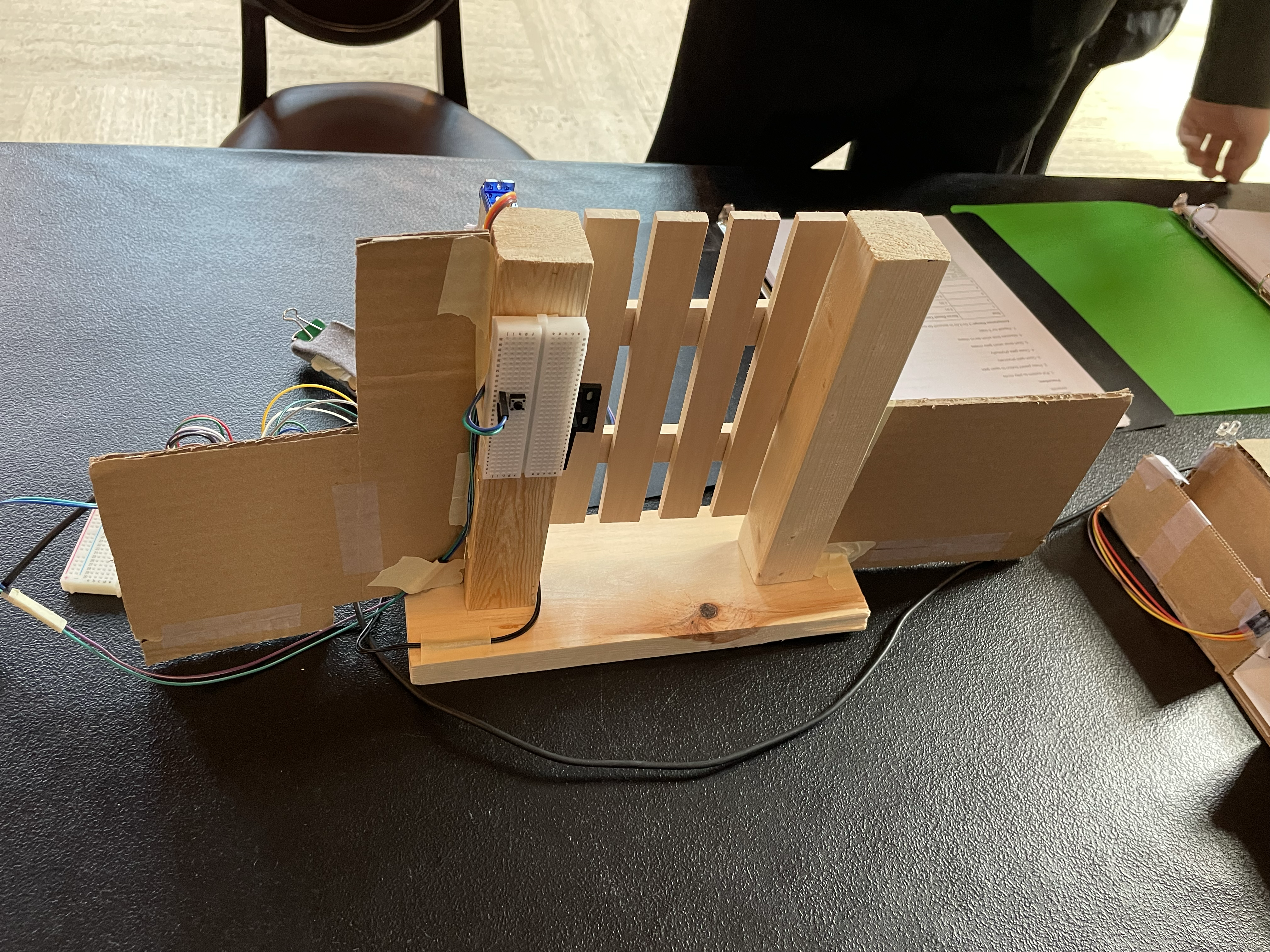
- Gravity latch at 1548 mm — operable from inside by staff at any time; lifted externally only when servo is triggered by wristband or push button
- Servo motor actuates the latch in response to authorized signals, enabling keyless, hands-free entry
- Magnetic contact sensor (reed switch) detects gate open/close state and transmits real-time status to staff wristband via wireless connection
- Push button on exterior allows parents to request entry during non-transition periods, disabled by staff during child transitions
- Barrier panel extension dimensioned using 95th-percentile adult reach data to prevent unauthorized latch operation from outside
- Material: teak wood — selected for weatherproof durability in Canadian rain and snow without warping
Staff Wristband (battery-powered)
- Three operating modes: Transition (external button disabled, maximum containment), Playtime (normal operation), Clear (gates fully accessible)
- Vibration motor provides tactile alerts when any gate opens — removing the need for constant visual monitoring
- Mode-switching buttons allow staff to control all gates simultaneously from anywhere in the play area
Process & Methodology
Stakeholder Mapping and Value-Based Prioritization
The original design brief treated children as secondary stakeholders. Through team analysis, I reframed the hierarchy: staff and children as co-primary stakeholders (highest interaction frequency and safety consequence), parents and community as secondary. This reordering directly determined which trade-offs were acceptable.
Example application — push button feature: Enabling parents to press a button to enter is less convenient than open-access entry, which disadvantages parents. However, it eliminates the need for staff to monitor and manually unlock gates during transitions — directly reducing staff cognitive load. Because staff burden is weighted above parent convenience in our prioritization, this trade-off is not only acceptable but required.
This framework converted subjective design debates into structured, defensible decisions.
Steelmanning — Finding What We Missed
I applied steelmanning by systematically constructing the strongest possible argument against each aspect of our design. This process surfaced two failure modes:
Vulnerability identified and resolved: The gravity latch, while positioned at height, could be reached by an adult standing outside the gate. I proposed the barrier panel extension as a countermeasure, dimensioned using 95th-percentile reach data to ensure the latch remained physically inaccessible from the exterior.
Limitation identified and acknowledged: A standard gravity latch requires an inward pull to open, creating a potential crowd-crush hazard during emergency evacuation. Within the time and resource constraints of the project, this could not be resolved. Rather than omitting it from our submission, I documented it explicitly as a known limitation and prioritized it as the first iteration target for a future design cycle.
This shift — from presenting a design as "finished" to presenting it as "improved with acknowledged limitations" — reflects a more professionally accountable engineering posture.
Pugh Chart Analysis — Gravity Latch Height
Rather than averaging the research-backed range (1548 mm – 1808 mm) to produce 1678 mm, I used a Pugh chart to evaluate three representative heights against three criteria:
| Criterion | 1500–1600 mm | 1600–1700 mm | 1700–1800 mm |
|---|---|---|---|
| Prevents child reach (incl. jumping) | 0 | 0 | 0 |
| Reachable by adults | 0 | 0 | 0 |
| Material sustainability (SDG 12) | 0 | -1 | -1 |
All three heights meet the child safety and adult accessibility requirements. The differentiating factor is gate height: a higher latch requires a taller gate to keep the barrier panel above the latch, directly increasing material consumption.
Decision: 1548 mm — the minimum height that satisfies all safety requirements while minimizing material use in alignment with SDG 12: Responsible Consumption and Production.
This outcome is lower than the naive average (1678 mm) — demonstrating that evidence-based prioritization and averaging are not equivalent processes.
Key Results
- Staff monitoring workload: Reduced — vibration alerts eliminate the need for constant visual gate monitoring
- Child containment: Maintained across all three operating modes
- Parent access: Preserved via push-button request system, disabled only during transition periods
- Latch height: 1548 mm — justified by Pugh chart, not averaging; 8% lower material height than the range midpoint
- Security vulnerability (reach-over): Mitigated by barrier panels dimensioned to 95th-percentile reach data
- Known limitation: Emergency evacuation inward-pull conflict — documented and flagged for next iteration
Lessons Learned
Stakeholder prioritization is not consensus — it is a principled decision. In complex multi-stakeholder environments, satisfying all needs equally is often impossible and sometimes not even desirable. The value of a stakeholder map is not to identify what everyone wants, but to establish the order in which competing needs are resolved when trade-offs arise. Every design decision in this project flowed from that hierarchy.
Steelmanning is how you find what you didn't think to look for. I was not looking for an emergency evacuation risk when I applied the technique. By constructing the strongest argument against our own design, I surfaced a failure mode that would have been invisible in normal design review. This is now a standard step I apply before any design is finalized.
Acknowledging limitations is not a weakness in a design — it is a requirement of professional accountability. A design that omits known limitations is not stronger; it is less honest. Presenting the gravity latch push-direction issue alongside our solution gave evaluators and future designers an accurate picture of what we built and what remains to be done. That is what accountable engineering looks like.
View PDFs
Product Defense Documentation - view the research/content presented in more detail (PDF)
Engineering Design Portfolio - view report of this project and others (PDF)